Licisto to Flodabay – Isle of Harris Volume 1
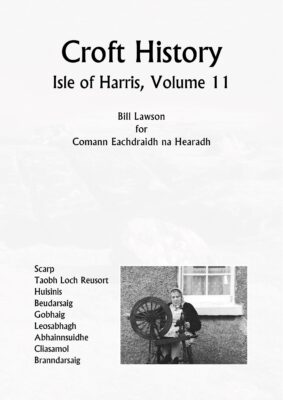
For this first volume of the Croft Histories of Harris, we have started on the Bays of Harris, beginning in the village of Liceasto (Likisto) and moving south through Geocrab, Aird Sleimhe (Ardslave) and Manais (Manish) to Fleoideabhagh (Flodabay), so covering the whole of the old Manais School area. All of these villages date from the 1790s, the period when Captain Alexander MacLeod of Bearnaraigh encouraged people to settle in the Bays as a part of his scheme for the development of fisheries on the island. The author has tried to cover the history of each croft from that time to the present day, though it has not always been possible to identify the earliest tenants with complete accuracy. Spiral Bound, 144 pages.
Kyles Scalpay – Isle of Harris Volume 2
Croft History of the villages of Urgha, Carraigrich (Carragrich) and Caolas Scalpaigh (Kyles Scalpay). 155 pages, genealogies and local history.
Cuidhtinis to Lingreabhagh – Isle of Harris Volume 3
This volume contains the Croft History for the villages of Cuidhtinis (Cuidinish), Aird Mhighe (Ardvey), Fionnsbhagh (Finsbay), Borsam and Lingreabhagh (Lingerbay) on the Isle of Harris. 141 pages.
Croft History Isle of Harris Vol 4 Leac a Li to Greosabhagh
This volume contains the Croft History for the villages of Greosabhagh (Grosebay), Cliuthair (Cluer), Caolas Stocinis (Kyles Stockinish), Leac a Li (Leaclee) and Aird Mhighe (Ardvey) on the Isle of Harris. Illustrated, 167 pages.
Vallay to Hougharry – North Uist Volume 1
Vallay to Hougharry croft histories and lots of photos. Includes the villages of Bhalaigh (Vallay), Griminis (Griminish), Scolpaig, Baile Loin (Balelone), Baile Mhartainn (Balmartin), Baile Locha (Baleloch), Hosta, Taigh Ghearraidh (Tigharry), Hoghaigearraidh (Hougharry) and Gobhlair (Goular). 144 pages.
Sollas area – North Uist Volume 2
Contains the Croft History for Malacleit (Malaclete), Ceathramh Meadhanach (Middlequarter), Dunsgealair (Dunskellor), Solas (Sollas) and Greinetobht (Grenitote) on the Isle of North Uist. 230 pages.
Grimsay – North Uist Volume 3
This volume contains the Croft History for Griomasaigh (Grimsay) and Ronaigh (Ronay) in North Uist. 145 pages.
Clachan to Boreray – North Uist Volume 4
This volume contains the Croft History for Orasaigh (Orinsay), Ath Mhor (Ahmore), Trumaisgearraidh (Trumisgarry), Bhalacuidh (Vallaquie), Reumaisgearraidh (Reumisgarry), Clachan Shannda (Clachan Sands), Goulabaidh (Goulaby), Baile Mhic Coinein (Newton (part)), Baile Mhic Phail (Newton (part)), Port nan Long (Newton Ferry), Caolas Bhearnaraigh (Kyles Berneray) and Boirearaigh (Boreray) on the Isle of North Uist. 157 pages.
Balranald to Balemore – North Uist Volume 5
The Croft History for the villages of Baile Raghaill (Balranald), Paiblisgearraidh (Paiblesgarry), Cnoc an Torran (Knockintorran) and Baile Mor (Balemore) on the Isle of North Uist. 175 pages.
Glendale to Garrynamonie – South Uist Volume 1
The Croft History for the villages of Cille Bhrighde (West Kilbride), Taobh a’ Chaolais (East Kilbride), Gleann Dail a Deas (South Glendale), Smercleit (Smerclete), Gearraidh na Monadh (Garrynamonie) and Trosairidh (Trossary) on the Isle of South Uist. 111 pages.
Iochdar – South Uist Volume 2
General history, croft histories, photos and maps of Iochdar (Eochar) on the Isle of South Uist. 136 pages.
Boisdale – South Uist Volume 3
Boisdale area, north & south and South Lochboisdale. Includes Baghasdal (Boisdale), Leth Mheadanach (South Boisdale), Taobh a Deas Loch Baghasdail (South Lochboisdale), Gleann Dail a Tuath (North Glendale) and Bagh Thartabhagh (Bahartivagh). 168 pages, with maps and local history.
Kilpheder – South Uist Volume 4
Cille Pheadair (Kilpheder) is one of the oldest townships in South Uist. This volume contains the Croft History for this township. 116 pages.
Borve – Berneray Volume 1
The Croft History for Borgh (Borve) on the Isle of Berneray.
Berneray (Ruisigearraidh) Volume 2
The Croft History for Ruisigearraidh (Rusigarry) on the Isle of Berneray.
Croft History of St Kilda
Pre 1822 families, 1822 census and croft histories. 35 pages
Sheshader – Isle of Lewis Volume 1
Includes Sheshader – a word picture, crofting pattern, croft histories and a guide to photographs. 87 pages.
Bayble – Isle of Lewis Volume 2
Includes Pabail – a word picture, croft histories of Pabail Uarach (Upper Bayble), Pabail larach (Lower Bayble), Cnoc na h-lolaire (Eagleton) and a guide to photographs. 171 pages.
Ness Part 1 – Isle of Lewis Volume 3
The Croft History for Cuisidar (Cuishader), Sgiogarstaidh (Skigersta), Eorodal (Eoradale) and Am Port (Port of Ness) in Ness, Isle of Lewis. 136 pages.
Crossbost – Isle of Lewis Volume 4
The Croft History for Crosbost (Crossbost) on the Isle of Lewis. 90 pages.
Tolsta Chaolais to Doune Carloway – Isle of Lewis Volume 5
The Croft History for Tolastadh a’ Chaolais (Tolstachulish) and Dun Charlabhaigh (Doune Carloway) in Carloway, Isle of Lewis. 138 pages wirebound.
Ranish – Isle of Lewis Volume 6
The Croft History for Ranais (Ranish), Isle of Lewis. 125 pages.
Grimshader – Isle of Lewis Volume 7
The Croft History for Griomsiadar (Grimshader), Isle of Lewis. 69 pages.
Melbost/Branahuie – Isle of Lewis Volume 8
The Croft History for Mealabost (Melbost) and Braigh na h-Uidhe (Branahuie), Isle of Lewis. 153 pages.
Barvas and Brue – Isle of Lewis Volume 9
The Croft History for Barabhas Uarach (Upper Barvas) and Bru (Brue), Isle of Lewis. 131 pages.
Coll – Isle of Lewis Volumes 10 and 11
History of the villages of Coll and Upper Coll – scene of land-raiding after the First World War. 247 pages.
(Volumes also available separately)
Volume 10 covers Coll 1-52 and Volume 11 covers Coll 53-88 and Upper Coll.
Coll – Isle of Lewis Volume 10
This is the first part of two volumes on the Croft History of Coll, Isle of Lewis. This volume covers Coll 1-52. 140 pages.
Upper Coll – Isle of Lewis Volume 11
This is Part 2 of the Croft History for Coll, Isle of Lewis. This volume covers Coll 53-88 and Upper Coll. 107 pages.
Leurbost, Lochs – Isle of Lewis Volume 12
This is the Croft History for Liurbost (Leurbost), Isle of Lewis, covering the villages of Liurbost (Leurbost), Am Baile Ur (Newholdings) and Crothaigearraidh (Croigarry). 174 pages.
Galson, High Borve, Mid Borve, Melbost Borve – Isle of Lewis Volume 13
This book celebrates the land buyout by Urras Oighreachd Ghabhsainn. The volume covers the Croft History of the villages of Borgh Mheadhanach (Mid Borve), Am Baile Ard (High Borve), Mealabost Bhuirgh (Melbost Borve), Gabhsann bho Dheas (South Galson) and Gabhsann bho Thuath (North Galson). 152 pages.
Leumrabhagh (Lemreway) and Am Pairc – Isle of Lewis Volume 14
This volume contains the Croft History for the villages of Leumrabhagh (Lemreway), Orasaigh (Orinsay), Stiomrabhagh (Stimerway), Isgein (Eishken), Am Pairc (Park) and Ath Linne (Aline). 178 pages.
Tolsta (Part 1) – Isle of Lewis Volume 15
This is the first of two parts on the Croft History of Tolsta, Isle of Lewis. This volume covers Gleann Tholastaidh (Glen Tolsta) and Tolastadh (Tolsta) Part 1. 160 pages.
Tolsta (Part 2) – Isle of Lewis Volume 16
This is the second part of the Croft History on Tolsta, Isle of Lewis. This volume covers Tolastadh (Tolsta) Part 2 and Am Baile Ur (Newholdings). 132 pages.
Back (Am Bac) – Isle of Lewis Volume 17
Illustrated detailed history of this Lewis village and the people.
Achmore and Lochganvich – Isle of Lewis Volume 18
This volume covers the Croft History of the villages of Acha Mor (Achmore) and Loch a’ Ghainmhich (Lochganvich). 123 pages.
Sgeulachdan a Seisiadar (Tales from Sheshader) – Book
Tales from the village of Sheshader, Isle of Lewis.
Sgeulachdan a Seisiadar (Tales from Sheshader) – CD
Tales from the village of Sheshader, Isle of Lewis.
Tiugainn do Scalpaigh (Poems of Scalpay, Harris)
This book compiles songs/poems written by John Morrison of Scalpay, Isle of Harris.
St Kilda and its Church
This book, dealing with the historical background to various items of interest connected with St. Kilda and its Church, is the third in a series looking at various historical sites in the Western Isles.
The Isle of Taransay
This book, dealing with the historical background to various items of interest connected with the offshore island of Taransay. 44 pages.
The Churches at Howmore
This book, dealing with the historical background to various items of interest connected with the Churches at Howmore, South Uist.
44 pages.
The group of ruins around the graveyard of Howmore are a testimony to the power and wealth of the Church in that area in their day. Little remains of the original two churches, but that little is still enough to impress visitors with the sheer scale and ornate nature of the buildings. Nothing is known of the early history of the site. Was it one of the early, pre-Norse, centres of the Celtic Church, or did it rise with the victory of the Gaelic culture over the Norse in the thirteenth century? John MacDonald, VIII of Clanranald, was buried there in 1584, and it is clear that the churches had been long established by that date.
The Teampull at Northton and the Church at Scarista
This book, dealing with the historical background to various items of interest connected with the Churches at Northton and Scarista, is the fourth in a series looking at various historical sites in the Western Isles.
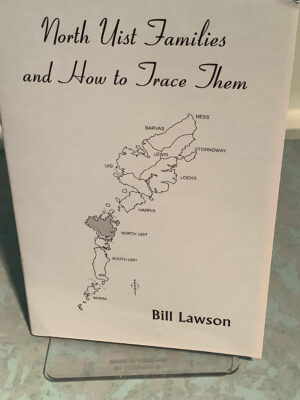
Harris Families and How to Trace them
The first edition of ‘Harris Families and How to Trace Them’ was published in 1990, and major advances in research and in availability of source materials since then have made a new edition necessary, both for those with a specific interest in genealogy, and also those with a more general interest in the history of these interesting and beautiful islands off the Atlantic coast of Scotland.
Lewis Families and How to Trace them – Part 1 – Ness
This book, the second of a series on different parishes in the Western Isles, is suitable for those with a specific interest in genealogy, and also those with a more general interest in the history of these interesting and beautiful islands off the Atlantic coast of Scotland.
Lewis Families and How to Trace them – Part 2 – Lochs
This book is the third of a series on different parishes in the Western Isles, and is suitable both for those with a specific interest in genealogy, and those with a more general interest in the history of these interesting and beautiful islands off the Atlantic coast of Scotland.
Index to the Marriages (Recorded and Unrecorded) in the Parish of South Uist (including Benbecula) 1820-1855
This register comprises an index to the marriages recorded in the Old Parish Registers of Marriages in the Parish of South Uist, including Benbecula, where the earliest Registers of Marriages do not commence until 1829. It contains approximately 750 entries from the Marriage Registers, and over 500 unrecorded marriages.
Isle of Harris – Index of Marriages 1820-1855 (Recorded and Unrecorded)
This register comprises an index to the marriages recorded in the Old Parish Registers of Marriages in the Parish of Harris, where the OPR does not commence until 1828 on the main islands, and 1823 on the Island of St. Kilda. It contains approximately 140 entries from the OPR, and over 600 unrecorded marriages.
Lochs Parish, Isle of Lewis – Index of Marriages 1820-1855 (Recorded and Unrecorded)
This register comprises an index to the marriages recorded in the Old Parish Registers for the Parish of Lochs on the Isle of Lewis. The OPR for Lochs Parish, which at that time included the areas of Carloway and Shawbost, does not commence until 1831. The index contains over 600 marriages from the Lochs OPR and a further 400 marriages in that parish obtained from other sources.
Index to the Marriages (Recorded and Unrecorded) in the Parish of North Uist 1820-1855
This register comprises an index to the marriages recorded in the Old Parish Registers for the Parish of North Uist, where the OPR does not commence until 1821. This index contains over 300 marriages from the North Uist OPR and a further 500 marriages in that parish obtained from other sources.
Index to the Marriages (Recorded and Unrecorded) in the Parish of Barvas (including Ness) 1810-1855
This register comprises an index to the marriages recorded in the Old Parish Registers for the Parish of Barvas on the Isle of Lewis. The OPR for Barvas Parish commences in 1810 and is the most comprehensive of all the OPRs in rural Lewis. This index contains over 1000 marriages from the Barvas OPR and a further 150 marriages in that parish obtained from other sources.
Register of Emigrant Families from the Western Isle of Scotland to Ontario, Canada PT. 1 – Bruce, Grey and Huron Counties
Anyone who has family originating in the Outer Hebrides of Scotland and immigrating to Bruce Grey, Huron and Kincardine Townships will find this book invaluable in collecting genealogical information on their ancestors. 95 pages.
Register of Emigrants from the Western Isles of Scotland Barvas Parish
Register of Emigrants from Barvas Parish (including Ness) on the Isle of Lewis, giving details of over 300 emigrant families. Listed by destination. 101 pages.
Chi Mi ‘n Tir (Harris Songs)
This book compiles a selection of Gaelic songs from Harris.
The Teampull on the Isle of Pabbay
History of the church and the parish with individual records of residents that emigrated and those who didn’t. The island was cleared in 1846, with many going to Cape Breton and Australia
St Clement’s, Rodel, Isle of Harris
The Church of the MacLeods of Harris and Skye. History, gravestone inscriptions, listing of 22 tenant farmers in 1680 as well as short histories of individuals back to 1547. 44 pages.
St Columba’s at Uidh, Isle of Lewis
The Church of the MacLeods of Lewis. History of the church, stories of individual residents of the parish going back to 1498 and gravestone inscriptions. 44 pages.
Register of Emigrants from the Western Isles of Scotland to the Eastern Townships of Quebec
This was Bill Lawson’s first book, published in Canada by the Compton County Museum. It is the first major genealogical listing of 350 families who emigrated from the Hebrides to Quebec.
Ancient Barra
This colourful guide presents the story of life in Barra from the appearance of the first stone age hunter-gatherers up to 10,000 years ago, to the crofters of the last century. It offers a vivid account of the development of the islands, suggesting some of the most rewarding places to visit and providing clear descriptions of each site.
Keith Branigan, as Professor of Archaeology and Prehistory at the University of Sheffield, led a major campaign of archaeological investigation and excavation in Barra in the 1990s, discovering and recording hundreds of previously unknown sites. This pioneering work has made possible our understanding of ancient Barra.
Ancient Lewis & Harris
This colourful guide presents the story of life in Lewis and Harris from the appearance of the first stone age hunter-gatherers up to 10,000 years ago, to the crofters of the last century. It offers a vivid account of the development of the islands, suggesting some of the most rewarding places to visit and providing clear descriptions of each site.
Dr Christopher Burgess has been County Archaeologist at Northumberland County Council since 2002, but for many years has led campaigns of archaeological survey and investigation in the Outer Hebrides and especially in Lewis, leading to significant advances in our understanding of the human landscape of the islands.
South Uist Archaeology
South Uist, at the southern end of the Western Isles, is only 22 miles long and, even though it is without the stone circles of other Scottish isles, it is covered in archaeological sites. This well-illustrated archaeological study places South Uist within a tradition of island archaeology, arguing that this island, just like most others, is fascinating because of its isolation and for the ways in which its occupants have chpsen to make contact with the outside world. Following a discussion of the island’s geology, the book begins a chronological tour through its archaeological remnants, placing all within their historical context. South Uist is shown to be rich in archaeology from the Neolithic onwards, including chambered tombs, Beaker sites, a Bronze Age hoard, roundhouses (one of which contained a mummified human burial), brochs, cairns, ogham insciptions, Viking settlements, medieval longhouses and post-medieval industry. At times, the archaeology reveals evidence of a troubled past. Illustrated throughout and includes a list of sites to visit. 224p, 114 b/w illus, 18 col pls (Tempus 2004)
Archaeology of Skye & Western Isles
From the Callanish stones and the great ritual monuments of the Neolithic, the broch towers and the wheelhouses of the Iron Age, through to the arrival of the Norse and the Lords of the Isles, this book explores the history of human settlement and society from the first hunter-gatherers to the Clearances. What emerges is a Hebridean archaeology as distinctive as those of Orkney and Wessex.
Anthology of Aesops Fables
For over 2,500 years the simple stories and wry humor of Aesop’s fables have entertained children and adults alike. Their lessons have seeped into the very fabric of our language, as evidenced by expressions such as “sour grapes” and “a wolf in sheep’s clothing.”
Through the centuries many artists have risen to the challenge of interpreting their favourite tales. In this magnificent edition, award-winning illustrator Helen Ward has chosen a dozen of her favorite fables, painstakingly creating with words and breathtaking watercolors a dazzling new collection destined to become a classic.
Cockerel & The Fox
In this work, award-winning artist Helen Ward retells the La Fontaine fable about a proud cockerel and his scrape with a cunning fox.
Home Sweet Hamish
Hamish is larger than life—and just a little bit clumsy and a tiny bit messy. Hamish is clumsy just once too often and his animal friends banish him from their house. But it is cold and snowy outside and soon the animals start to feel guilty. So they come up with a perfect plan to make Hamish feel very welcome indeed. This is a charming picture book with a reassuring message about friends overcoming problems together.
Rocks & Minerals Sticker Book
Reading level: Ages 9-12
Paperback: 20 pages
Sounds of the Wild – Nighttime
Nighttime is hardly quiet. It’s filled with a world of strange and curious sounds. Now children discover all of the amazing animals that are wide awake when they are fast asleep in this delightful new book from best-selling author and illustrator Maurice Pledger. Sounds of the Wild Nighttime brings together incredible pop-up panoramas and mysterious animal sounds to give little ones a glimpse into the mysterious, after-dark world. They journey to the European woodland, and hear the calls of tawny owls on the hunt, then it’s off to the sunset shadows of the Mediterranean where they can listen to noisy cicadas. The moonlit tour continues on to the Rocky Mountains, the Everglades and the Malaysian jungle, rumbling with the majestic roar of the Indo-Chinese tiger. This wonderful nighttime adventure makes an educational and entertaining bedtime book.
Sounds of the Wild – Ocean
This gorgeously illustrated pop-up book takes readers deep beneath the water’s surface where they are greeted with a symphony of new sounds. This aquatic adventure features a humpback whale that communicates with noisy roars and sighs and whose “songs” carry for hundreds of miles underwater. Children also discover the playful chattering of dolphins, the boisterous honking of seals, and much more. Maurice Pledger’s cunningly engineered pop-ups create an unforgettable 3-D seascape.
Sounds of the Wild – Birds
Are you ready to soar? Young readers can let their imaginations take flight in Sounds of the Wild: Birds, the extraordinary new title from acclaimed illustrator Maurice Pledger. Five dazzling 3-D pop-up panoramas are enhanced with real bird sounds, bringing the wondrous world of birds to life. With colorful, detailed artwork and informative text, this book takes readers on a journey across the globe — from lush wetlands and tropical forests to remote deserts and mountains — to discover all types of birds big and small.
Utterley Otterlies, The
Synopsis
The Utterly Otterley family live in a cosy burrow near the river where everything is just about perfect. Until Pa Utterly Otterley wakes up one morning and decides it’s time to find a new home.
Scotland The Creation of its Natural Landscape
Colliding continents, erupting volcanoes and moving ice sheets are some of the ways in which the diversity of Scotland’s natural landscape was created. In the distant geological past, Scotland travelled towards the South Pole and wandered the southern hemisphere, before drifting to its present latitude. In the process it passed through all the Earth’s climatic zones. The landmass which we now call Scotland carried an ever-changing cargo of plants and animals, many of them now extinct.
Truth about St Kilda
The Truth about St Kilda is a unique record of the isolated way of life on St Kilda in the early part of the twentieth century, based on seven handwritten notebooks written by the Rev. Donald Gillies, containing reminiscences of his childhood on the island of Hirta. It provides a first-hand account of the living conditions, social structure and economy of the community in the early 1900s, before the evacuation of the remaining residents in 1930.
Crowdie & Cream
Based on a childhood in Harris – wonderful story-telling from the well-known broadcaster, Finlay J MacDonald.
Harris Way of Life
The story of Marion Campbell, a Harris weaver. Sixty years after she first started weaving Marion was still making tweeds in the manner of her youth. During the summer months especially, there was a constant stream of visitors to her loom shed in Plocropool. They came from all over the world.
History of Finsbay Lodge
Detailed and authoritative history of Finsbay Lodge, home of the Hebridean Sporting Association, and much of its surroundings. The author has unearthed an amazing amount of detailed information, not just about the Lodge and the characters that were drawn to it and to Harris, but also relating to the fish and fishing. Evocative glimpses of unique Hebridean life for both local and visitor at the beginning of the 20th century and at the start of the First World War.
Isle Called Hirte
A classic and vivid overview of the history and culture of St Kilda up to the time of the evacuation in 1930. Includes detailed treatment of the population and families, their homes, shielings, bothies and storehouses, domestic life, pastoral and arable farming, fowling and fishing, customs and beliefs, stories and songs, religion, education and health, and communications. 338pp hardback, including many diagrams and illustrations.
Life & Death of St Kilda
On 29 August 1930 the remaining 36 inhabitants of this bleak but spectacular island off Scotland’s western coast took ship for the mainland. A community that had survived alone for centuries finally succumbed to the ravages that resulted from mainland contact. What their lives had been like century after century, why they left, and what happened to them afterwards is the subject of this fascinating book. It is the story of a way of life unlike any other, told here in words and pictures, and of how the impact of twentieth-century civilisation led to its death.
This 297 page paperback by Tom Steel is one of the most popular books about St Kilda and is a highly recommended read. It contains numerous old photos.
Lord of the Isles
A reprint of Nigel Nicolson’s book about Lord Leverhulme and his involvement with the islands of Lewis and Harris after the first World War, when he devised a plan to ‘rescue’ the islanders and introduce them to a ‘new’ prosperity as he saw it.
264 pp, pbk
Memories of Scarp
In this well-illustrated booklet, Donald John Macleod brings together his own personal memories of life on the island, together with a series of anecdotes and contributions which vividly illustrate what it was like to be a resident of Scarp during the last century. It will be of absorbing interest to all who have visited this now depopulated island, or have gazed wistfully across the narrow sound of water near Husinish, Harris, to the clearly visible buildings on a green strip of land which once formed a living community.
Natural History of St Kilda
A vast canon of literature has been produced over the years on St Kilda, most of which has focussed on the resilient people who have lived there, but before now none have focussed on the natural history of the island, nor has such a book been written by a native resident.
In 1697 Martin Martin, a Gaelic-speaking scholar from Skye, travelled to St Kilda to study the island’s flora and fauna and to learn about the now extinct great auk. Much of the information that he gathered during this expedition was relayed to him by the islanders. Naturalists from Martin down to Robert Atkinson in 1938, not only witnessed the people’s way of life but also the wildlife around them, both priceless assets that have recently won for St Kilda dual World Heritage Site status.
A Natural History of St Kilda is a synthesis of what these naturalists and scientists experienced and gives evidence that shows just how important wildlife was to the survival of the islanders. Much of this information has lain for years in little known private diaries, files, reports or obscure scientific journals. John Love puts background and personalities to the names whilst describing the natural features of the islands of St Kilda, creating a fascinating and insightful account which will appeal not only to naturalists, but to all who are fascinated by the St Kilda, by its human history and by islands in general. Its remoteness and inaccessibility are notorious but one need not have set foot on St Kilda to enjoy this book.
Sea Room
Sea Room describes – and relives – a love affair with three tiny islands in the Hebrides which the author has owned for the last twenty years. The Shiants (the name means the holy or enchanted islands) are a wild and dramatic place, with 500 foot high cliffs of black columnar basalt, surrounded by tide rips, filled in the summer with hundreds of thousands of seabirds and with a long and haunting history of hermits, shipwreckers, famine and eviction. Adam Nicolson’s father, Nigel, bought them as an Oxford undergraduate in 1937 for £1,400 and gave them to his son on his 21st birthday. They became the most important thing in his life, not only an escape but as the source of a deep engagement with the natural world in some of its most beautiful, alarming and all-encompassing forms.
Private: St Kilda & the Wider World
St Kilda, now a World Heritage Site and once home to the most remote community in Britain, has long been seen as a place of tragedy. Sepia images of intrepid seabird hunters and the abandoned village street have been used to evoke a heroic, ultimately doomed ‘struggle for existence’on the edge of the Atlantic, a struggle that ended with the evacuation of 1930. This book, the first general account for thirty years, reconsiders the islanders’ story and presents a radical new interpretation. Adnrew Fleming argues that this tale of inevitability doesn’t do the St Kildans justice. They have often been regarded as exotic, but as the photographs of ordinary children in the book show, they were not so very different from other Hebrideans. The archipelago was settled by a hard-working, viable community well before 2000 BC; in prehistoric and Norse times, St Kilda may in fact have played a pivotal role in the region. Well into the Victorian period St Kilda was a well-organised, economically diversified and culturally rich community, which dealt effectively with outsiders and won their sympathy.
Indeed the St Kildans themselves colluded with the wider world to create the iconic island of today. Andrew Fleming retells a fascinating tale and reveals a wealth of new archaeological discoveries into the bargain. This is an essential book for all those fascinated by the realities of island life.
St Kilda Steamers, The
The full story of the steamer services from the Scottish mainland to St.Kilda, from the visit of the first steamship in 1834. In particular, the story of John McCallum and Martin Orme, and the steamers ‘Hebrides’, ‘Hebridean’, and ‘Dunara Castle’.
Castles of the Lews
Peter Cunningham has provided an English volume which will merit a place on the bookshelves of all those with island connections, bringing to the reader a sensitive and at times humorous analysis of island history. He is best known for his national reputation as an expert on birds and has published the still sought after A Hebridean Naturalist with Acair in 1979.
Children of the Blackhouse
Calum Ferguson employs an unusual narrative technique, drawing on his mother Màiread’s reminiscences, and presenting her experiences and conversation in the first person. Màiread herself was most at home speaking Gaelic, though she never learned to read or write in that language, but only in English, the compulsory language at school.
This is a fascinating account of a culture in transition; it records and preserves for twenty-first-century readers traditions and ways of life which have now gone for ever. In the early years of the twentieth century many crofting families in Lewis lived in great poverty. This book describes that life: the limited diet, the seasonal round of work, the hardship, but also the richness of the culture, the storytelling, music-making, dancing, and the sincere religious faith that sustained the islanders through their trials.
Diary 1851
An eye witness account of mid 19th century life on the Island of Lewis by the Factor to Sir James Matheson.
168 pp
Guga Hunters
The Guga Hunters tells the story of the men who voyage to Sulasgeir each year and the district they hail from, bringing out the full colour of their lives, the humour and drama of their exploits. They speak of the laughter that seasons their time together on Sulasgeir, of the risks and dangers they have faced. It also provides a fascinating insight into the social history of Ness, the culture and way-of-life that lies behind the world of the Guga Hunters, the timeless nature of the hunt, and reveals the hunt’s connections to the traditions of other North Atlantic countries. Told in his district’s poetry and prose, English and – occasionally – Gaelic, Donald S. Murray shows how the spirit of a community is preserved in this most unique of exploits.
View from North Lochs, A
Writing under the pseudonym ‘Aimsir Eachann’, the late Hector Macdonald scribed a brilliant weekly column that gave a voice to the Scottish Gael at the end of the 20th century.
Inspired by the great Irish writer Brian O’Nolan, who published novels under the pseudonym Flann O’Brien but wrote for the Irish Times as ‘Cruiskeen Lawn’, Aimsir Eachainn commented for more than fifteen years from North Lochs, creating an array of unforgettable characters, eccentric scenarios, magnificent satire and enraged comment, all of which were entwined with an effortless humour and grace.
Born in Ranish on the Isle of Lewis in 1945, Hector Macdonald worked for the Met Office for several years before beginning a career at the Stornoway Gazette in 1979. This was the first outlet for his weekly columns before he was poached by the West Highland Free Press. Under the tutelage of Brian Wilson he found a true home for a style of writing that could be described as thought provoking, sometimes irreverent, but nearly always funny. Over a period of more than fifteen years he wrote in the region of eight hundred columns for the West Highland Free Press under the guise of Aimsir Eachainn before his death in 1995.
Lewis in the Passing
Positioned at the uppermost tip of Britain and facing the battling winds of the Atlantic, the Isle of Lewis has always had a strong identity of its own. A community defined by tradition for hundreds of years, the twentieth century presented huge challenges to its way of life, leaving it completely altered by the arrival of the millennium. Lewis in the Passing is a form of time-capsule, containing twenty-one autobiographical sketches of Lewis natives, all born before the Second World War. From crofter to musician, house-wife to clergyman, the selection spans the spectrum of Lewis society. Theirs are lives which have experienced these great changes, from economic disaster in the 1920s, to mass emigration in the 1930s, the ‘obscenity of battle’ during the Second World War, and afterwards the decline of the Gaelic language and the slow demise of crofting. All are interviewed by fellow islander Calum Ferguson, who presents his subjects’ stories and journeys, and understands how, in spite of the rainy climate and wind-blasted scenery, the island’s hidden magnetism continues to draw them all ‘back home’.
Living Past, The
Donald Macleod, who is professor at the Free Church College in Edinburgh, looks at the past and present. Written in the form of an exchange of letters between the author and a friend’s daughter, it will captivate all those who came to maturity in the Sixties, and act as a reminder of links between that time and the present, as well as recalling earlier characters and events familiar to many. Will be of interest also to religious historians and those reared in a religious ethos.
More Views from North Lochs
Inspired by the great Irish writer Brian O’Nolan, who published novels under the pseudonym Flann O’Brien but wrote for the Irish Times as ‘Cruiskeen Lawn’, Hector MacDonald, writing as the great Aimsir Eachinn, commented for more than fifteen years from North Lochs, creating an array of unforgettable characters, eccentric scenarios, magnificent satire and enraged comment, all of which were entwined with an effortless humour and grace.
Nessman, The
The main theme of the book is death – death of a father, of an identity, of a sense of self, of a language. In tandem with that, The Nessman is also about the agent of Colin’s personal destruction – alcohol.
Yet the book is not a depressing read. It is hilariously funny, brilliantly observed and written with an astonishing ear for dialogue and eye for character. Colin’s knowledge of himself as he spirals towards destruction is unsparing and unsentimental. The result is an extraordinary and moving portrayal of a people and a culture.
This is the first book in English of the people of Ness and it is one of the first novels in which a Gaelic writer has, with utter confidence, made English his own language too.
Norse Mills of Lewis
This new book sets its small horizontal island mills within the social and historical life of the island. It seeks to answer where these mills may have come from, given that their every part is to be found in horizontal mills in many countries in Europe and beyond. Were they, for example, introduced by Viking settlers – hence their being named Norse Mills – or were they brought at an earlier period by Celts from Ireland where there is concrete evidence of their early use? The book contains a detailed gazetteer of over 250 sites where mills were once worked throughout the island, along with a map reference for each and a simple grading of the condition of the sites. Almost all these sites are ruins of the former mill building and lade. The book is extensively illustrated with pen and ink drawings and a range of photographs and other images.
Praising the Guga
Donald S Murray’s new collection of poetry is called Praising the Guga. It is a stunning series of poems that examines the world of the guga and its place in the culture and cuisine of Donald’s native Ness in the Isle of Lewis.
Guga is the name given to the young gannets harvested annually from Sulasgeir, 40 miles north east of the Butt of Lewis. The birds form a traditional part of the diet in Ness, and it is a tradition that continues to this day.
The pamphlet is being launched alongside Donald’s book The Guga Hunters (Birlinn), a brilliant account of the world of the guga. Together these works tell a unique and fascinating story of a community, a way of life, and their relationship with the beautiful and enigmatic gannet.
Whisky Galore
The hilarious story of wartime bootlegging in the Scottish islands. Wartime food rationing is bad enough, but when the whisky supplies run out on the Hebridean islands of Great and Little Todday, nothing seems to go right. Then the fifty-thousand-bottle cargo of the shipwrecked S. S. Cabinet Minister brings salvation – in its most giddily intoxicating form.
Barra & The Bishops Isle
Keith Branigan and Patrick Foster trace the development of settlement in the beautiful, marginal landscape of the southern isles of the Outer Hebrides, from 6000 years ago to the migration that saw thousands sail to North America.
Vatersay Raiders, The
Tells the story of the raiders; their struggle to escape from the poverty which, they claimed, the policies of the absentee landowner forced them to endure, the raiding and settlement of the island and the fraught process of dividing it up into crofts. This book also outlines subsequent developments in Vatersay, including the causeway.
Furrow Behind Me, The
The autobiography of Scottish crofter and Gaelic storyteller, Angus MacLellan. Reminiscences of his life were first recorded – on tape in Gaelic – in the early years of the 1960s and later transcribed and translated by John Lorne Campbell into this English-language biography.
Angus MacLellan was regarded throughout his own lifetime as one of Scotland’s finest traditional Gaelic storytellers. Reminiscences of his life were first recorded – on tape in Gaelic – in the early years of the 1960s and later transcribed and translated by John Lorne Campbell into this English-language biography. Born in 1869 into a poverty-stricken crofting community on South Uist, Angus MacLellan spent his childhood and his youth with his family before travelling from the island to find work first in the militia and then on the farms of the mainland. His travels came to an end when he returned to assist and eventually to succeed, his parents on their croft on South Uist in 1896. Angus MacLellan’s memory for detail and his gift for telling should bring to the reader a vivid picture of a harsh lifestyle encompassing two centuries of dramatic change.
Polly
Early on a wartime winter’s morning in 1941, an 8,000-ton cargo ship loaded with whisky ran aground in the beautiful and treacherous seas of the Outer Hebrides. The events which followed became the stuff of folklore, and resulted in the famous fiction of Whisky Galore. But what really happened … ?
Stories From South Uist
This is an extraordinary collection of tales from one of the very greatest Gaelic Storytellers, Angus MacLellan, and translated by one of Scotland’s finest Celtic scholars, John Lorne Campbell. The stories in the book include every type of tale found on the island of South Uist, from Fingalian heroes and ghost stories to international folktales and humorous and historical local anecdotes.
Tales & Travels of a School Inspector
John Wilson was an Inspector of Schools during the latter half of the nineteenth century and the beginning of the twentieth. His career in education spanned 50 years, during which time he inspected many schools in the Highlands and Islands, including Jura, Islay, Orkney, Argyll, Heisker and Iona. First published in 1928, the personal account of his experiences is both compassionate and humorous, providing a valuable insight into the social and educational conditions in the Gaelic Highlands and Islands following the 1872 Education Act.
Tales from an Island
This omnibus edition of Christina Hall’s memoirs brings together her two books, To the Edge of the Sea and Twice around the Bay.
To the Edge of the Sea is an enchanting and moving memoir; Christina Hall writes with sharp observation about her childhood on the Hebridean island of South Uist in the 1940s and 50s. Humour and anguish reflect the spirit of a girl living through a time of dramatic change in her life, her family and the land that she loves. Beginning with her earliest memories, the book recounts her life up to the end of secondary school and is set in Uist, Benbecula, Barra and Fort William.
As a sequel to To the Edge of the Sea, Twice Around the Bay follows Christina Hall’s story during her time at teacher training college in Glasgow and her return to the Hebrides, where she became the primary school teacher at South Glendale on her native island of South Uist. It is a story full of vibrancy, life and colourful Hebridean characters which recaptures with crystal clarity the joys and hardships of island life in the late 1950s and 1960s. It was during this period that the army arrived on Benbecula, and it was through them that Christina met a young English soldier. The book ends with their wedding, with faith in the future and the realisation that wherever that future might lead, the island of Christina’s birth would always be part of her.
Tales from Barra
John MacPherson, also known as ’The Coddy’, was one of the most renowned storytellers and characters of the Western Isles at the turn of the nineteenth into the twentieth century and beyond, and was the inspiration for Compton MacKenzie’s Whisky Galore. His warmth and personality shine through these stories, which are a wonderful mix of myth, tradition and anecdote.
This edition includes a large number of traditional tales told in the inimitable style of The Coddy, grouped in a number of themed sections: Tales of the Macneils of Barra and Other Lairds – The MacLeods of Dunvegan – The Laird of Boisdale – Stories of Olden Times – Ecclesiastical Traditions – Place-names – Tales of Treasure – Tales of Local Characters – Stories of the Politician – Stories of Sea Monsters – Fairies, Second Sight and Ghost Stories – Witchcraft.
For any student of folklore, for anyone interested in the traditions and history of the islands, or for anyone who simply likes a tale well told, The Coddy is essential reading. This edition is enhanced with a plate section consisting of period photographs of the Western Isles and informative notes on The Coddy and his stories.
Uists & Barra
The islands of North and South Uist, Barra and Benbecula are at the southern end of the Outer Hebrides. This guide describes everything the visitor needs to know about the islands’ heritage, landscape, climate, flora and fauna
Age of the Clans
This is the first overview of Highland society ever to be written which covers the period from the rise of Somerled to the first clearances. The period has been chosen as one of considerably continuity and the book deals with four main themes – the changing political relationships and tensions within the region, the clans, their composition, alliances, strongholds and patterns of display the changes in settlement over time, and the economy of the Highlands and Islands.
Most books on the Highlands concentrate either on crofting or on high politics, but without a full understanding of the dynamics of society, much of Highland history is difficult to comprehend. This book is not a dry economic narrative, but a lavishly illustrated story of a society in many ways unique in Europe, a story of feasting in great halls such as Dunvegan, of the galley fleets of the great lords, of strange pagan survivals in ritual and belief, and of a magnificent oral tradition. This is both a new and exciting view of a society too often dismissed either as a backward relic of the past or combed through for similarities with Scotland south of the Highland line.
Alba
By 1124 a powerful feudal kingdom, based in Edinburgh and descended from the Kings of Dalriada, had been established. Gaels and Vikings fought for supremacy in the Western Isles and the kingdoms of the Picts and the Britons had disappeared. The lines between the the kingdom of the Scots and the recently established Norman dynasty to the south and the relationship between them had still to be established but the lines of Scotland’s future development were now clear.
This then was a period of revolution which established a new nation. It is arguably the most important of all in Scottish history. And yet it is one of the least known. It is this period of change that Stephen Driscoll describes with a wealth of new evidence and reconstruction illustration. From the royal palaces and burial sites of the kings of Strathclyde to the great inaugurations of Scone, this is an age of now vanished pageantry and power when the imperial ambitions of the new kings of Scots were shown in the names they chose, when those kings travelled on pilgrimage to Rome, and when names of almost mythological stature – Macbeth, Kenneth MacAlpin, St Margaret – lived and breathed in a new nation of Scots.
Culloden & The Last Clansman
An armed uprising. A conspiracy. An assassination. A hanging. These events, starting with the crushing of Jacobite rebels at Culloden in 1746 and culminating six years later in the so-called Appin Murder, provided Robert Louis Stevenson with the plot of his enduringly popular novel Kidnapped. But truth can be every bit as dramatic as fiction. And never more so than in this account of what lay behind the killing of government officer Colin Campbell by a hidden gunman on a May afternoon in 1752.
Campbell was on his way to evict rebels from the Ardshiel estate near Appin, and Britain’s rulers saw in his murder a terrorist act committed by Jacobite survivors of Culloden. When the alleged killer evaded a Scotland-wide manhunt and escaped abroad, politicians insisted someone had to pay for Campbell’s death.The sacrificial lamb was James Stewart, a Culloden veteran who had been organising resistance to Campbell’s evictions. James was found guilty in the show trial that followed and was hanged close to the murder scene. His body was left suspended there for years as a grim warning to anyone else thinking of challenging the new order the British state had imposed on the Jacobite Highlands.
Dance Called America, A
A new dance is devised on the Isle of Skye in the eighteenth century. An exhilarating dance. A dance, one visitor reports, that ‘the emigration from Skye has occasioned’. The visitor asks for the dance’s name. ‘They call it America,’ he is told.
Now James Hunter, one of Scotland’s leading historians, provides the first comprehensive account of what happened to the thousands of people who, over the last 300 years, left Skye and other parts of the Scottish Highlands to make new lives in the United States and Canada.
The product both of painstaking research and extensive travels in North America, this is the definitive story of the Highland impact on the New World, the story of how soldiers, explorers, guerrilla fighters, fur traders, lumberjacks and pioneer settlers from the north of Scotland found, on the other side of the Atlantic, freedoms and opportunities denied to them at home.
William Wallace & That
William Wallace And All That is a real-life adventure packed with historical facts about Scotland’s legendary hero. Join Sir William Wallace on his fearsome quest to free the Scots from villainous King Edward and his evil empire. Growl with anger as you find out what nasty things Edward’s vile henchmen did to Wallace’s girlfriend and best pal. Get splattered with blood and gore as Wallace makes haggis of his enemies. Gasp with terror as you learn about the giant ‘hedgehogs’ that helped Wallace win battles. Groan with agony as you feel what it’s like to be hanged, drawn and quartered. Discover how Wallace’s grisly death made his legend grow.
Aimed at children aged 8-12
* Learn how to tell the difference between Wallace facts and Wallace nonsense.
* Discover why Wallace had to do his homework in Latin.
* Understand what made King Edward attack Scotland in the first place.
* Find out why the Victorians turned Wallace into stone.
Glencoe & The Indians
In 1876, they wipe out General George A. Custer and his 7th Cavalry at the Battle of the Little Bighorn. Chief Sitting Bull and his Sioux people then flee from the United States to Canada. There, in the autumn of 1877, the Sioux are joined by the remnants of the latest Indian nation to make a stand against the US Army, the Nez Perce. Their survivors are led by Chief White Bird. A young man follows White Bird to Sitting Bull’s camp. He is White Bird’s close relative and aims to tell the story of the Nez Perce War from the Nez Perce point of view. This young man’s name is Duncan McDonald. Descended from chiefs of the Nez Perce and from chiefs of Scotland’s most formidable clan, Duncan’s family – first as Highlanders, then as Native Americans – have twice been victims of massacre and dispossession. Written with the help of Duncan McDonald’s present-day kinsfolk on the Flathead Indian Reservation in Western Montana, this real-life family saga spans two continents and more than thirty generations to link Scotland’s clans with the native people of the American West.
Highland Clearances, The
This is the first fully documented study for many years of one of Scotland’s most emotive subjects. It traces the origins of the Clearances from the eighteenth century to their culmination in the crofting legislation of the 1880s, showing how the process of clearance was part of a wider European movement of rural depopulation. Eric Richards describes the appalling conditions and treatment suffered by the Highland people, yet at the same time illustrates how difficult the choices were that faced even the most benevolent landlords in the face of rapid economic change.
The Clearances were the most rugged and painful of many attempted ‘solutions’ to the problem of those who maintain a population on marginal and infertile land. In drawing attention away from the mythology or the hard facts of what actually happened, this book offers a balanced analysis of events which created a terrible scar on the Highland and Gaelic imagination, the historical legacy of which still lies unresolved in the twenty-first century.
Robert The Bruce & All that
Robert the Bruce and All That is a real-life adventure packed with historical facts about Scotland’s warrior king. Gallop alongside King Robert the Bruce as he takes up the quest to free the Scots from terrifying King Edward and his bumbling son, Edward II. Voyage with Bruce to the mysterious islands of the west, and read about the secret plan to win over his kingdom. Discover what happened to Bruce’s queen and sisters when they were seized by the enemy. Learn how to capture a castle as Bruce and his men topple enemy fortresses across the land. Hear skulls crack as Bruce sends Edward II homeward to think again at the Battle of Bannockburn. Follow Bruce’s amazing life after death as his heart is taken into battle in Spain – and find out how it was safely returned home.
Aimed at children aged 8-12
* Learn about Bruce’s dark secrets as well as his heroic deeds.
* Discover how well Bruce really got on with William Wallace.
* Understand why Bruce’s Declaration of Independence is big in America.
* Find out how Bruce became the original Spider-Man.
Scottish Exodus
Millions of Scots have left their homeland during the last 400 years. Until now, they have been written about in general terms. Scottish Exodus breaks new ground by taking particular emigrants, drawn from the once-powerful Clan MacLeod, and discovering what happened to them and their families. These people became, among other things, French aristocrats, Polish resistance fighters, Texan ranchers, New Zealand shepherds, Australian goldminers, Aboriginal and African-American activists, Canadian mounted policemen and Confederate rebels. One nineteenth-century MacLeod even went so far as to swap his Gaelic for Arabic and his Christianity for Islam before settling down comfortably in Cairo. This gripping account of Scotland’s worldwide diaspora is based on unpublished documents, letters and family histories. It is also based on the author’s travels in the company of today’s MacLeods – some of them still in Scotland, others further afield. Scottish Exodus is a tale of disastrous voyages, famine and dispossession, the hazards of pioneering on faraway frontiers.But it is also the moving story of how people separated from Scotland by hundreds of years and thousands of miles continue to identify with the small country where their journeyings began.
When I Heard the Bell
The loss of the Iolaire remains the worst peacetime British disaster at sea since the sinking of the Titanic. Yet, beyond the Western Isles, few have ever heard of what is not only one of the cruelest events in our history but an extraordinary maritime mystery – a tale not only of bureaucrats in a hurry, unfathomable Naval incompetence and abiding, official contempt for the lives of Highlanders, but of individual heroism, astonishing escapes, heart-rending anecdote and the resilience and faith of a remarkable people.
Birds of Prey
Children can discover and learn to identify birds with these fun sticker books. More than 60 colourful reusable stickers. Create colourful bird scenes with the easy-peel stickers that can be used more than once, while also learning about the birds. Not suitable for children under 36 months.
Scottish Wild Flowers
An ideal pocket guide to over 350 plant species found throughout Scotland Packed full of information, Collins Scottish Wild Flowers is the ideal guide for both visitors and residents of Scotland who wish to learn about the fascinating wealth of wild flowers that can be found there. Each species is illustrated in full colour with a comprehensive description, plus the plant’s English, Latin and Gaelic names. For ease of use, the plants are grouped together by the type of habitat in which they can be found, including Highlands, Lowlands and Coasts. Habitats are arranged from those most influenced by humans, progressing towards wilder and more remote areas. The book includes a section with up-to-date details about places of interest and the best sites for finding some of the most attractive and special species of wild flowers in Scotland.
Butterflies
With informative and lively text this colourful booklet which has been written by Paul Kirkland, Director of Butterfly Conservation Scotland, introduces the fascinating life-cycles of butterflies, where you can find them and what we need to do to care for them. It also contains some of the most wonderful butterfly images ever to be published.
Corncrakes
Produced jointly with Royal Society for the Protection of Birds (RSPB), this shy, secretive bird is seldom seen but often heard. Its distinctive, rasping call evokes memories of a more rural past. Thanks to the efforts of the Scottish Natural Heritage (SNH) and RSPB, numbers of this threatened bird are again on the increase.
Discovering Scottish Plants
This book introduces the flowers and trees that grow in Scotland. Find out, season by season, how to identify common Scottish plants, their habitats, uses, folklore and history. Find out about Scottish plant collectors — intrepid explorers who had many exciting adventures plant hunting in the far-flung corners of the world. Many of the common plants growing in Scottish gardens today were introduced by them.
Flora Celtica
Flora Celtica: Plants and People in Scotland documents the continuously evolving relationship between the Scots and their environment from the Stone Age to the present day. Based on a mixture of detailed research and information provided by the public, it explores the remarkable diversity of ways that native plants have been, and continue to be, used in Scotland. The information is presented in clear and accessible format and is laced with quotations, illustrations, case studies and practical tips.
This volume covers the complete spectrum of plant uses, addressing their diverse roles in our diet, healthcare, culture, housing, language, environment, crafts, and much more. It is a book to delight, inspire and inform.
How to Identify Birds
A practical beginner’s guide to identifying birds. For the beginner, it can be hard to distinguish a crow from a rook, a raven and a jackdaw. How to Identify Birds uses a sophisticated new method to help you do just that. You learn to distinguish 30 key species and from there are taken to similar birds, taught exactly how you can spot the more subtle differences between species and to identify them accurately. Each entry includes: Numerous, specially-commissioned illustrations to show their behaviour and plumages / Scientific factfile to double-up as a useful reference / Distribution map and advice to suggest where you are most likely to find that species / Detailed, accurate illustrations show birds as you will see them in the wild.
Kelp Forests
An essential introduction to this hidden kingdom. Discover the variety of plants and animals which live in the ‘forests’, find out why kelp forests are so important in Scottish waters and how healthy kelp forests help to prevent coastal erosion.
Land of Mountain & Flood
This book is for those who are interested in the natural world and who wish to develop a good knowledge about the original formation of the formidable Scottish terrain. It is accessible and beautifully presented, contains a vast amount of detailed information told in clear, comprehensible language and is enhanced throughout with specially commissioned illustrations, diagrams and photographs.
Scottish Birds
Unlike many field guides, Collins Scottish Birds does not cover birds which only visit occasionally, or which occur in such small numbers and are so difficult to identify that only experienced birdwatchers can spot them. Instead, it concentrates on more common species that the amateur birdwatcher is most likely to see, plus a few scarcer ones of particular interest. Species are grouped according to the habitat in which they are most likely to be seen, with a detailed introduction to all the different habitats. There are also details of key identification features and behavioural characteristics which will help you identify each bird with accuracy and ease. Each entry includes a full-colour illustration, common name and Latin and Gaelic name, the season in which the bird is likely to be spotted, and details on habitat, feeding habits, and voice. The book also includes up-to-date details about places of interest and the best sites to go for birdwatching, with maps and contact information to help you get there. Packed full of information, Collins Scottish Birds is the ideal guide for both visitors and residents of Scotland who wish to learn about the fascinating wealth of birds that can be found there.
So Foul & Fair a day
Climate change is one of the most serious issues that faces the human race, but how important have climate conditions and weather been in the past? Alistair Dawson considers this question as he traces the history of climate conditions and weather in Scotland, showing that dramatic changes have played an important part in the shaping of Scotland’s story, a fact that is often overlooked by professional historians.
He discusses the key lessons to be learned from the past, providing pointers to the future and new meanings to the terms ‘climate change’ and ‘global warming’. This is a fascinating and thoughtful book, and an invaluable reference for all those interested in climate change.
Seaweed & eat it
“Seaweed And Eat It” is the foodie’s answer to “The Dangerous Book for Boys”, and a nostalgic journey of rediscovery for the whole family. Part cookbook, part natural history guide, with tasty recipes, fascinating folklore and inspiring ideas for seasonal feasts, “Seaweed” leads the reader through the process of identifying, learning about and cooking unusual and wild native foods. From discovering edible wild plants and flowers, to creating delicious seasonal feasts, “Seaweed” puts the fun into foraging and injects a sense of adventure into preparing dinner. For anyone interested in the origins of their food – or who’s shocked by the price of elderflower cordial – this inspirational cookbook will ensure mealtimes are never dull.
Gaelic is Funtastic
Gaelic is Funtastic is the follow-up to the fabulous book Gaelic is Fun, the perfect introduction for a beginner who has previously been deterred by the language’s difficult reputation. Like the first edition, it uses a combination of conversations, cartoons and comprehensible instructions, and continues with the same lesson structure of breaking each section down into digestible and clear steps, gradually revising and building on the knowledge gained from the first book. Role-play conversations and distinctive cartoon formats introduce new situations and vocabulary to the student in fun and interesting ways, communicating basic Gaelic words, phrases and sentences. This book is accessible, amusing and easy to use, designed throughout with Elwyn Ioan’s distinctive illustrations.
Lazy Way to Gaelic
No lessons. No pain. Just pictures. This course books offer a taste of learning the Gaelic through comic-like pictures.
Scots Gaelic
The purpose of this book is to provide a brief introduction to the Gaelic language with a selective discussion of its main features.
In contrast to native speakers, who absorb the language as children, adults who are learning Gaelic from scratch often derive much benefit from knowing why the language takes shape as it does.
This easy to follow guide keeps things as simple as possible to accommodate readers who may be taking a first look at the language, but those whose knowledge of Gaelic is a little more advanced also find the book useful.
Tracing your Scottish Family History
Gives you an expert helping hand in retracing your family’s past.
Scottish Surnames
This revised and expanded edition includes data on over 220 families, the develompment of surnames, a reading list and a guide for beginners in search of ancestry and family history.
Kingdom of MacBrayne, The
The Kingdom of MacBrayne tells the story of David MacBrayne, his ships and his company, his predecessors, rivals and successors.
Scots Kith & Kin
Scots Kith and Kin is a compact and comprehensive guide to over 4,000 Scottish family names and their clan affiliations. Whether you are a Highlander curious in your local heritage or a second generation Scot living abroad and piecing together your origins, this book will enable you to track down your roots. Whether you are an Abbott or a Yuill the easy-to-use book will enable you to find:
Where and when your surname originated
The clan to which you belong
The history of your clan
It is also a fascinating key to understanding all the other names which you may be heir to and features a fold-out colour map of Scotland showing the homelands of the clans and illustrating significant events in Scottish history.
Above Scotland
The landscape of Scotland is full of dramatic contrasts. The high, rugged peaks of the Cairngorms look down on the rounded hills of the southern uplands. Wild moorlands run into fertile flood-plains. The coastline ranges from soft sandy beaches and crystal-clear waters to jagged cliffs battered by the fierce waves of the Atlantic. Aerial photography provides unique and striking perspectives on how the people of Scotland have lived, worked, fought over, worshipped, developed and changed this land, leaving no part untouched or unaltered by human activity. The Royal Commission on the Ancient and Historical Monuments of Scotland (RCAHMS) holds the national collection of aerial photography with millions of images dating from the 1920s to the present day. These photographs – many of which have never been seen before by the public – tell the remarkable story of a changing nation, from stone circles, Roman remains and ruined castles, to the growth of villages, towns and cities, the rise and fall of heavy industry, the country at war and the proud engineering and architecture of the modern landscape. For the first time in one volume, RCAHMS has brought together the finest images from its collection in a stunning illustration of Scotland’s past, present and future.
Outer Hebrides, The
The photographs in this book cover remote mountains, hills, coastline and deserted islands. Additionally featured are churches, ruined castles, ancient graveyards, fishing vessels, Harris tweed factories and standing stones, bringing a different perspective to the Outer Hebrides.
Scotland From Space
This book has images of Scotland from over 400 miles above the Earth in true colour. It contains state-of-the-art high resolution satellite images giving close up details with fascinating captions about Scotland’s landscape.
Scotlands Coast
Following the success of his best-selling First Light, Joe Cornish has now turned his attention to the magnificent scenery of Scotland’s 6,000-mile coastline. He has travelled from the Mull of Galloway in the south to the tip of Unst in the Shetlands, the northernmost point in the British Isles, and from remote St Kilda out in the Atlantic to the Sands of Forvie National Nature Reserve on the North Sea to capture the enormous variety of scenery that characterises the Scottish seacoast. Some of the sites he has photographed, like St Kilda or the sandstone peaks overlooking Loch Torridon, belong to the National Trust for Scotland, but many others are privately owned; some, like the majestic Cuillins on Skye, are well-known to tourists, others are hidden coves or remote sea stacks that few visitors will ever have seen. Whatever the subject, be it a wide Hebridean vista or fragmentary patterns of ice on a frozen beach, Joe Cornish, with his artist’s eye and his dramatic use of light, helps us to look at it afresh and reveals new and unsuspected beauties. In the text which accompanies his photographs he explains the aspects of each particular landscape that made it special to him, its geology, its flora, its history or its associations. The result is a stunning book book which will delight Cornish’s legion of admirers and all those who have found enchantment on Scotland’s wonderful coastline.
Wanderings with a Camera
Photography of Erskine Beveridge
This lavishly illustrated volume highlights a selection of the finest photographs taken by Beveridge between 1880 and 1919. With a biographical introduction by Lesley Ferguson, “The Photography of Erskine Beveridge” illustrates one of Scotland’s most remarkable photographic collections.
Buddhism for Sheep
Sheep are seriously underestimated creatures when it comes to spirituality and religious feeling. For the first time, this book recognises their huge potential and offers every ovine student of Buddhism the opportunity to focus their skills and follow the path to enlightenment.
Sea Dog Bamse
This is the remarkable – and bestselling – story of one of the Second World War’s most unusual animal heroes – a 14-stone St Bernard dog who became global mascot for the Royal Norwegian Forces and a symbol of freedom and inspiration for Allied troops throughout Europe.
Soil & Soul
It is easy to feel helpless in the face of the torrent of information about environmental catastrophes the world over. In Soil and Soul, Scottish writer and campaigning academic Alastair McIntosh shows how it is still possible for individuals and communities to take on the might of corporate power and emerge victorious.
Alastair’s beliefs are rooted in his upbringing on the Isle of Lewis. The first part of his book explores how the old way of life in the Hebrides was threatened with extinction by global capitalism. He does not advocate returning to a preindustrial golden age, but balances the gains of modernity against what has been lost. In particular, he demonstrates how the rise of the modern era undermined communities governed by a sense of reverence and mutual responsibility. But right relationship can be restored, he suggests, by learning from the bardic tradition to create a new harmony of soil, soul and society. The second part of the book demonstrates how such principles of community empowerment can be successfully applied. As a founder of the Isle of Eigg Trust, Alastair helped the beleaguered residents of Eigg to become the first Scottish community ever to clear their laird from his own estate. In a campaign that earned worldwide renoun, the islanders raised sufficient funds to oust their landlord , very much against his will, and successfully galvanized political demands for land reform in Scotland. Similarly, plans to turn a majestic Hebridean mountain into a roadstone “superquarry” were overturned after Alastair persuaded Native American War Chief Sulian Stone Eagle Herney to visit the Isle of Harris and testify at the government inquiry.
This extraordinary book weaves together theology, mythology, economics, ecology, history, poetics and politics as the author journeys towards a radical new yet ancient philosophy of community, Spirit and place. His daring and imaginative responses to the destruction of the natural world make this an uplifting, inspirational and often richly humorous read.
Hell & High Water
After Alastair McIntosh’s success with Soil and Soul which sold more than 10,000 copies, Birlinn Limited is pleased to introduce a major new work which critically examines climate change citing Scotland’s ecosystem as a microcosm for wider global effects.
I Crossed the Minch
Louis MacNeice provides a unique insight into Hebridean culture of the late 1930s. This is a fascinating social historical document of what Scottish rural life was like in these times.
No Great Mischief
In 1779, driven out of his home, Calum McDonald set sail from the Scottish highlands with his extensive family. After a long, terrible journey, Calum settles his family in “the land of the trees” until they become a separate Nova Scotian clan, with its own identity and history. From the greatest living Canadian novelist, this novel is a true classic.
Peat & Peat Cutting
For thousands of years peat was the main fuel that warmed houses all over the British Isles, and the mark of the peat cutter is written deep in the landscape. This book is a celebration of a cultural history that extended from the Iron Age to the twentieth century. It tells the story of the use of peat for fuel in the British Isles, and the people who cut it. It also examines the methods of cutting, the tools that were used, and the organization of cutting. It chronicles the beginning of commercial extraction and the exhaustion of this precious resource.
Ring of Bright Water
Hailed a masterpiece when it was first published, the story of Gavin Maxwell’s life with otters on the remote west coast of Scotland remains one of the most lyrical, moving descriptions of a man’s relationship with the natural world. Introduced by John Lister-Kaye.
Calums Road
Calum MacLeod had lived on the northern point of Raasay since his birth in 1911. He tended the Rona lighthouse at the very tip of his little archipelago, until semi-automation in 1967 reduced his responsibilities. ‘So what he decided to do,’ says his last neighbour, Donald MacLeod, ‘was to build a road out of Arnish in his months off. With a road he hoped new generations of people would return to Arnish and all the north end of Raasay . . .’ And so, at the age of 56, Calum MacLeod, the last man left in northern Raasay, set about single-handedly constructing the ‘impossible’ road. It would become a romantic, quixotic venture, a kind of sculpture; an obsessive work of art so perfect in every gradient, culvert and supporting wall that its creation occupied almost twenty years of his life. In Calum’s Road, Roger Hutchinson recounts the extraordinary story of this remarkable man’s devotion to his visionary project.
Ancient Uists
This colourful guide presents the story of life in the Uists from the appearance of the first stone age hunter-gatherers up to 10,000 years ago, to the crofters of the last century. It offers a vivid account of the development of the islands, suggesting some of the most rewarding places to visit and providing clear descriptions of each site.
Island of Wings
On the ten-hour sailing west from the Hebrides to the islands of St Kilda, everything lies ahead for Lizzie and Neil MacKenzie. Neil is to become the minister to the small community of islanders and Lizzie, his new wife, is pregnant with their first child. Neil’s journey is evangelical: a testing and strengthening of his own faith against the old pagan ways of the St Kildans, but it is also a passage to atonement. For Lizzie – bright, beautiful and devoted – this is an adventure, a voyage into the unknown. She is sure only of her loyalty and love for her husband, but everything that happens from now on will challenge all her certainties. As the two adjust to life on an exposed archipelago on the edge of civilization, where the natives live in squalor and subsist on a diet of seabirds, and babies perish mysteriously in their first week, their marriage – and their sanity – is threatened. Is Lizzie a willful temptress drawing him away from his faith? Is Neil’s zealous Christianity unhinging into madness? And who, or what, is haunting the moors and cliff-tops? Exquisitely written and profoundly moving, Island of Wings is more than just an account of a marriage in peril – it is also a richly imagined novel about two people struggling to keep their love, and their family, alive in a place of terrible hardship and tumultuous beauty.
Two Views of Harris: Na Hearadh Bho Dha Shealladh
Lesley and Alisdair Wiseman have been coming to Harris for over twenty years. Their paintings are realised from different perspectives.
Alisdair’s work is minutely detailed, while Lesley emphasises abstract qualities on silk.
The book contains a total of 80 prints, all in colour.
(Bilingual)
Maurice Pledger’s Oscar Otter Sticker Book
Inside, you’ll find over 150 stickers. Use them to make your own pictures as you explore the river and shore with Oscar and his animal friends.
Maurice Pledger’s Bobby Bear Sticker Book
Inside, you’ll find over 150 stickers. Use them to make your own pictures as you explore the field and forest with Bobby and his animal friends.
Maurice Pledger’s Ozzy Owl Sticker Book
Inside, you’ll find over 150 stickers. Use them to make your own pictures as you have fun learning about all sorts of animals with Ozzy and his friends.
Maurice Pledger’s Billy Bunny Sticker Book
Inside, you’ll find over 150 stickers. Use them to make your own pictures as you have fun learning about counting and colours with Billy and his animal friends.
Little Book of Camper Van
Anyone who has ever driven a Volkswagen camper will appreciate the appeal of this unique vehicle with its styling and versatility. Over the years it has given joy to millions of people and is now synonymous with the surfing culture that has become so popular today. But the origin of this legend dates back to a darker time when the determination of Adolf Hitler saw the birth of the iconic Beetle.
By the end of the Second World War, stripped down Beetles were being used as trucks to ferry parts around the Wolfsberg factory but Ben Pon – the First to see Volkswagens outside Germany – saw its true potential and was instrumental in the arrival of the Type 2 T1 camper van (or bus as it was affcetionately known) in 1950.
The VW camper has seen many changes over the years but is still going strong today.
Excavations at Northton, Isle of Harris
BAR British Series 408 2006
Presents the site of Northton in the Western Isles of Scotland. During excavations in 1965 and 1966, two early horizons were identified beneath and close to the base of the machair sands.
Gift Certificate – £10
Can be redeemed against purchases from the web site including books or genealogical services including the forthcoming online genealogical search tools. The perfect gift for the keen genealogist. You will be sent an email containing a code that can be redeemed by you, or by your chosen recipient, at the checkout stage of the HebridesPeople.com web site.
When Kafka met Einstein
A new collection of poems including Poems from the Hebrides by James Knox Whittet.
A quietly amazing collection of poetry – Pauline Stainer.
These Islands We Sing
An Anthology of Scottish Islands Poetry edited by Kevin MacNeil
Poems exploring themes of love, language, landscape, identity and belonging.
A celebration of poetry and place.
Lewis in History and Legend Vol 1 (West Side)
The Isle of Lewis, the largest and the most northerly of the islands of the Outer Hebrides, has had an eventful story from prehistoric times through to the present. Evidence of human occupation stretches back to 3000 BC, explicit in the iconic silhouettes of the Standing Stones at Callanish. After the Vikings left in the ninth century, the clans of West Scotland quickly moved in, and Lewis was the site of many feuds between the Morrisons, the MacAulays and the MacLeods. The island operated largely independently until it was purchased by the MacKenzies in 1600 and was finally drawn into Scotland
Tir a Mhurain
In 1954 Paul Strand and his wife Hazel spent three months traversing the rugged island of South Uist, off the west coast of Scotland. “Tir a’Mhurain” is a collection of photographs that reflects the impressions they gathered during their stay. Juxtaposing people and landscape, Strand’s beautifully sequenced photographs depict the perfect complicity he saw between nature and habitation in this wild terrain. This new edition of “Tir a’Mhurain,” which includes rare images never before published, is a true masterpiece of photography.
Gift Certificate – £20
Can be redeemed against purchases from the web site including books or genealogical services including the forthcoming online genealogical search tools. The perfect gift for the keen genealogist. You will be sent an email containing a code that can be redeemed by you, or by your chosen recipient, at the checkout stage of the HebridesPeople.com web site.
Tales & Trads. Of the Lews
Tales and Traditions of the Lews is a marvellous pot pourri of local history, myth and legend from prehistoric times to the present day.
Scottish Pioneers of Upper Canada
Glengarry, Upper Canada’s first major Scottish settlement, was established in 1784 by Highlanders from Inverness-shire. Worsening economic conditions in Scotland, coupled with a growing awareness of Upper Canada’s opportunities, led to a growing tide of emigration that eventually engulfed all of Scotland and gave the province its many Scottish settlements. Pride in their culture gave Scots a strong sense of identity and self-worth. These factors contributed to their success and left Upper Canada with firmly rooted Scottish traditions.
Individual settlements have been well observed, but the overall picture has never been pieced together. Why did Upper Canada have such appeal to Scots? What was their impact on the province? Why did they choose their different settlement locations? Drawing on new and wide-ranging sources author Lucille H. Campey charts the progress of Scottish settlement throughout Upper Canada. This book contains much descriptive information, including all known passenger lists. It gives details of the 550 ships, which made over 900 crossings and carried almost 100,000 emigrant Scots. The book describes the enterprise and independence shown by the pioneers who were helped on their way by some remarkable characters such as Thomas Talbot, Lord Selkirk, John Galt, Archibald McNab and William Dickson. Providing a fascinating overview of the emigration process, it is essential reading for both historians and genealogists.
Gift Certificate – £50
Can be redeemed against purchases from the web site including books or genealogical services including the forthcoming online genealogical search tools. The perfect gift for the keen genealogist. You will be sent an email containing a code that can be redeemed by you, or by your chosen recipient, at the checkout stage of the HebridesPeople.com web site.
Register of Emigrants from the Western Isles of Scotland Volume 2, Part 2, South Uist & Benbecula 1840-1900
This volume gives the Register of Emigrants from the Isles of South Uist and Benbecula from 1840 to 1900. Details of over 350 emigrant families whose destination has been discovered is given, in addition to another 350 families who are known to have left, but whose destination is as yet unknown. Listed by destination. 137 pages.
Gift Certificate – £100
Can be redeemed against purchases from the web site including books or genealogical services including the forthcoming online genealogical search tools. The perfect gift for the keen genealogist. You will be sent an email containing a code that can be redeemed by you, or by your chosen recipient, at the checkout stage of the HebridesPeople.com web site.
Lewis in History and Legend – The East Coast
NEW – BILL LAWSON’S 60TH BOOK
The Isle of Lewis, the largest and most populous of the islands of the Outer Hebrides, has had an eventful history which stretches back thousands of years. In this eagerly awaited second volume of Lewis in History and Legend, Bill Lawson deals with the townships of the east coast of the island, from Tolsta in the north to the boundary with Harris in the south, and with Stornoway, the commercial and administrative capital of the island.
In his own inimitable style, he traces the story of the island from earliest times to the present day, describing the landscape and the physical remains of the past. More importantly, however, he excels in charting the history of the people themselves, weaving his way through the centuries with stories drawn from documented sources, oral tradition, Gaelic song and from his own experiences of many years travelling around the island and researching the history of its families.
The result is a unique insight in to the way of life and history of an island.
Bill Lawson founded the genealogy centre Co Leis Thus? and is genealogical consultant to Northton Heritage Trust, which now runs this research service. He has written sixty books on the genealogies and history of the western Isles. He regularly researches and lectures in North America and Australia. He lives in Northton, Harris.
Register of Emigrants from the Western Isles of Scotland Volume 1 Isle of Harris 1750-1900
Listed by destination. This volume gives details of over 300 emigrant families whose destination has been discovered, in addition to over 100 other families who are known to have left Harris, but whose destination is as yet unknown. 87 pages.
An Unstoppable Force
This book provides the first exhaustive study of the great Scottish exodus to Canada written in modern times. This book is essential reading for those who wish to understand why they came and the enormity of their achievements in Canada.
Soapman, The
In 1918, as the First World War was drawing to a close, the eminent liberal industrial Lord Leverhulme bought – lock, stock and barrel – the Hebridean island of Lewis. His intention was to revolutionise the lives and environments of its 30,000 people, and those of neighbouring Harris, which he shortly added to his estate. For the next five years a state of conflict reigned in the Hebrides. Island seamen and servicemen returned from the war to discover a new landlord whose declared aim was to uproot their identity as independent crofter/fishermen and turn them into tenured wage-owners. They fought back, and this is the story of that fight. The confrontation resulted in riot and land seizure and imprisonment for the islanders and the ultimate defeat for one of the most powerful men of his day. The Soap Man paints a beguiling portrait of the driven figure of Lord Leverhulme, but also looks for the first time at the infantry of his opposition: the men and women of Lewis and Harris who for long hard years fought the law, their landowner, local business opinion and the entire media, to preserve the settled crofting population of their islands.
North Uist in History and Legend
Like all the Hebrides, North Uist has a fascinating history, and a landscape scattered with historic sites, from Neolithic burial chambers and Iron Age forts, though medieval churches and battle-sites, to townships forged in the days of kelp trade, and the subsequent traumas of clearance and emigration. Of all the Western Isles, none has closer links with the turbulent history of Clan Donald than North Uist, and stories of their chiefs and battles are linked with sites all through the island, all set in a landscape which is one of the most varied and beautiful in the Hebrides.
Bill Lawson has woven a tapestry of stories about the island and its people, drawing on formal recorded history and also the rich tradition of story and song in which the informal history of the people was passed down, but also incorporating many of his personal reminiscences of his travels through the island, to give a unique insight into North Uist and the life of its people through the ages.
Lewis – A History of the Island
The remarkable history of the Hebridean Isle of Lewis stretches back to the time of the Norse invaders (and there are significant prehistoric remains from before that time). Over the centuries, Lewis has seen a succession of powerful landlords come and go, and this ground-breaking book recounts the long-fought struggle over the land. It also describes many aspects of the islanders’ way of life over the years — agriculture and fishing, education in Gaelic and English, the Church and the people, law and order and smuggling, emigration and the armed services are just some of the topics included in this wide-ranging survey. Combining original research with a deep personal knowledge of the subject, Donald Macdonald’s Lewis: A History of the Island is a remarkable example of local history.
Description of the Western Isles of Scotland
A Description of the Western Islands of Scotland Circa 1695 and a Late Voyage to St Kilda: Description of the Occidental i.e. Western Islands of Scotland
One of the greatest travellers in Scotland, Martin Martin was also a native Gaelic speaker. This text offers his narrative of his journey around the Western Isles, and a mine of information on custom, tradition and life. Martin Martin’s wrote before the Jacobite rebellions changed the way of life of the Highlander irrevocably. The volume includes the earliest account of St Kilda, first published in 1697 and Sir Donald Monro, High Dean of the Isles, account written in 1549 which presents a record of a pastoral visit to islands still coping with the aftermath of the fall of the Lords of the Isles.
Harris in History and Legend
This is the story of the communities and people of Harris in history and legend. One of the largest and most famous of all the islands of Scotland, astonishingly little has been written about the varied and eventful life of Harris, perhaps because the island has been so self contained. Including much material on the now deserted islands around Harris, including new information on St Kilda, Bill Lawson’s book is the first modern account of Harris and those who have shaped its history over thousands of years.
Everyday Gaelic
Everyday Gaelic has been compiled by an author with many years’ experience in teaching Scottish Gaelic to adults and children. In addition to basic words and phrases, it also includes more complex and idiomatic material, all arranged thematically and covering topics such as meeting and greeting, travelling, the weather and eating and drinking. There are also clearly explained sections on grammar and imitated pronunciation for all Scottish Gaelic words and phrases. The result is an accessible and useful book which will be of benefit to all levels and ages of learners.
Designed to be used with or without the accompaniment of the Everyday Gaelic book, the 80-minute-long CD features Scottish Gaelic phrases spoken by native speakers and arranged by topic. Each phrase is preceded by its English translation and followed by a pause to allow the learner to repeat the phrase. Helpful for both comprehension and pronunciation, this CD is particularly useful for learners without access to a native speaker.


Bookmark on